Category: Uncategorized

Portland Tree Permit Series: Permit Required for Private Properties

Starting in January 2015, most Portland tree removal projects will require a permit, in accordance with the city’s new Title 11 tree legislation.

The Title 11 Tree Plan (or the Citywide Tree Policy Review and Regulatory Improvement Project as it is formally known) was Urban Forest Pro tree removal services

passed in 2011, but full implementation was postponed until 2015. Title 11 set new guidelines on tree removal and pruning within Portland city limits. Previously, we have discussed timing your tree projects for completion before the new statute takes effect. We’ve also written an in-depth piece on all aspects of the Title 11 Trees rule. This post recaps important points as a friendly reminder to prepare for Title 11 now.

Here is an overview of some of the important changes that are taking place according to Title 11:

Improved Customer Service. An overall higher level of customer service is planned. New city staff members are being hired and a tree-only website is being built.

Focus on Preservation. New tree regulations focus on preservation first, especially for development projects. Developers are being asked to preserve existing trees whenever possible. Guidelines have also been revisited for Heritage Trees.

Clarity and Consolidation of City Regulations. Title 11 (Trees) and Title 33 (Land Use) will be consolidated. Coordination between these agencies will be improved.

Monitoring and Program Review. The new program will include more staff, program inspectors, and monitors that will continue to review policy and regulatory action.

Rules for Removal and Planting. What are the new rules going into effect this January, and how will the average homeowner be affected? The main change is that you will need a permit to remove any tree with a diameter of 12″ or more, and for trees that have been categorized as Heritage Trees. A fee is also required to remove these trees. These new regulations extend backyard trees, street trees, and trees that are from special overlay zones or plan districts. A permit will also be required to prune Heritage Trees.

Learning more. The city of Portland is making an effort to educate the citizens about the benefits of maintaining a healthy urban forest. The urban forest is vital to the lives to the lives of the people of Portland and to the sustainability of the city itself, as our green canopy provides both functional and aesthetic value. The city estimates that for every dollar spent on maintaining a healthy urban forest, we get three of value in return. Property owners play an important role in maintaining the urban forest and are expected to be aware of regulations. Those who do not educate themselves and follow the new guidelines may face fines.

Working with the City. Property owners can request a permit with City of Portland’s Urban Forestry department. The permit cost $35. Owners are requested to mark the tree in question with an orange ribbon, and a city arborist will be by within a week to inspect and (hopefully) approve the removal permit. In some cases, a pruning permit will be issued instead.

There are a number of circumstances that merit removal, namely dead, dying, or dangerous trees. Reasons that do not merit consideration for removal include:
–Excessive tree droppings (leaves, flowers, etc.)
–The tree is too tall and obstructs the view,
–The tree is perceived as making too much shade, and
–Excessive cost of maintenance.
Hazards that can be remedied by pruning will not be approved for removal.

Call Urban Forest Pro. While the city does try to make it easy for the average homeowner to obtain a permit, working with a professional tree service or arborist will speed up the process and is a convenient option. Our arborists will inspect your tree or trees, and apply for the proper permits. If we can’t offer tree removal services, because the tree doesn’t qualify according to new city regulations, we will let you know and suggest alternatives. You can count on us for a professional and timely response. Call us today and we will be glad to take a look at your trees.

This post first appeared on https://www.urbanforestprofessionals.com

Urban Forest Pro Project Spotlight: Where Do the Wood Chips Go?

It’s fall, and seasonal delights abound. Here at Urban Forest Pro, we’re making autumn stellar with wood chip donations. If you’ve ever wondered what happens to all the wood chips from our pruning and Portland tree removal services, now you know. We donate them to farms and events. For instance, Urban Forest Pro was able to provide all of the wood chips for this year’s Sauvie Island Pumpkin Patch and Corn Maze. We are also delighted that the Pumpkin Patch was able to donate these chips to a local farm, Kruger’s Farm Market, who in turn used them to help compost their plant waste materials.

Wood ChipsThe circle of life continues, and this year we are happy to contribute to this process while helping local communities at the same time. Let’s take a look at how we recycle wood chips, and how they benefit local ecosystems.

Nothing is wasted. When we remove a tree from a residential or commercial property, nothing is wasted. Usable timber is milled into lumber. Chips are used as mulch, and to combat invasive species. They also come in handy for rebuilding native habitats. Moreover, because wood chips are rich in carbon, farmers can use wood chips as a compost base for their compost. Healthy compost requires both carbon and nitrogen. We provide the carbon, in the form of wood chips, and farmers contribute plenty of leafy, nitrogen-rich greens.

Wood chips and nitrogen. It is true that wood chips and sawdust will deplete the soil of nitrogen, especially if mixed into soil that is used to grow nitrogen-hungry plants. But when the opposite occurs—when nitrogen is mixed in along with carbon—the result is a dark, loamy compost that provides many benefits to the soil and to plant health in general.

Compost happens. Compost happens, but it occurs slowly over time, especially in the cold, wet weather that we have here in Portland. It takes time for wood chips to decompose. If sawdust is used, the carbon-to-nitrogen ratio can be as high as 500 to 1. Ideally, the carbon-to-nitrogen ratio should be closer to 25 to 1. One thing farmers can do to facilitate this ratio is to include alfalfa meal. Alfalfa meal contains an almost perfect ratio of carbon to nitrogen and will help balance the soil and stabilize the composting process. Of course, if you have sawdust you can use it as material for walkways for a year while it decomposes. Alternatively, chips may be used as mulch, and then mixed into the ground after 1 to 2 years.

The Sauvie Island Pumpkin Patch Corn Maze 2014. As we mentioned at the onset, this year we were happy to contribute to the composting cycle on a commercial scale. First, we delivered chips that we had on hand from tree trimming to the Sauvie Island Pumpkin Patch. The chips were used for walkways and paths. After the Corn Maze was taken down, the chips and corn hops were collected and delivered to Kruger’s Farm Market, a local farm and market on Sauvie Island. (They also sell produce at several stands around town, including a tent you may have spotted on SE Hawthorne.) Since the chips and the corn material contained plenty of carbon, they were perfect for farmers, who had a lot of green material following the fall harvest. As of now, all that carbon and nitrogen are beginning to intermingle and break down. The result will be very valuable indeed for the farmers—and locavores!—come spring, as plants thrive.

This post first appeared on https://www.urbanforestprofessionals.com

How to Choose an Arborist

Healthy trees receive regular attention from knowledgeable arborists. But how can you tell when you choose an arborist if they’re truly an expert? Pick an inexperienced arborist, and your trees could suffer. Fortunately, there are ways to distinguish the true tree gurus from mere amateurs. In the following paragraphs we discuss how homeowners can find and select skilled arborists. We highlight questions to ask when hiring a professional, suggest which credentials to look for, and offer general tips about referrals and online reviews.

Call an arborist both to benefit from his or her expertise, and to stay safe throughout tree care tasks. Many tasks associated tree and shrub maintenance can be done at ground height, without the need of a ladder. However, if you are unable to access taller branches without the use of a ladder, it is best to call a professional. Working at height requires specialized training and equipment and is risky for the average homeowner because of the large number of variables, such as power lines, chainsaw manipulation, other buildings, etc.

Hiring the wrong contractor can have grave consequences for the health of your trees. Let’s take a look at some of the questions you should be asking arborists before hiring them for a project.

Questions to Ask before you Choose an Arborist in Portland

  • Can they provide up to date certification of insurance, as well as a copy of their work contract, or in Oregon, their Certified Arborists at workconstruction contractor number?
  • Do they have recent references? A quality company should be more than willing to provide up-to-date references.
  • Will they give you a detailed estimate? This should include information about how long the project will take, the kind of equipment that will be used, as well as information regarding accessing the trees safely.
  • What about a professional appearance? You can ask if the company uses spikes (which damages trees), offers “topping” (also harmful to trees), and if personal protection equipment (PPE) is used by all members while on a job site. Finally, ask how the workers will clean up the fallen leaves and branches that are trimmed away.

Credentials. As in all established fields, quality arborists tend to obtain industry certifications. Ask potential arborist contractors if they employ a Certified Tree Care Safety Professional (CTSP). You can also look for endorsements from the International Society of Arboriculture (ISA), and the Tree Care Industry Association (TCIA). For work that needs to be done near the electrical wires, the contractor will need to be an Approved Line-Clearance Arborist.

General tips for Selecting a Certified Arborist

Beware of scammers. Unfortunately, there are plenty of people who pose as tree care professionals, but who are undertrained and/or underinsured. Here are some tips to help you identify true tree care professionals, and steer clear of those who would do a substandard job.

  • ANSI A300. Quiz the people you talk to about ANSI A300 standards for tree trimming. See if they know about this.
  • Beware the use of certain terms such as “topping,” “lion’s tails,” and “hat racking.” These are often indications of an inexperienced or undereducated tree trimmer.
  • Be sure to ask for credentials, verification of insurance, customer recommendations, and a detailed work proposal. If any of these items are lacking, beware!
  • If you see differences in bid prices, it might be because a company is underinsured, or is under-experienced in estimating how many cuts—and therefore how much time—it will take to prune correctly. (The correct answer is about 1000; it takes about 1,000 cuts to expertly prune a tree.)
  • Ask about permitting required to remove most large trees. Portland has some stringent requirements about this, as well about which trees can be removed. Be careful to double check permitting requirements, especially if your contractor insists that no permit is needed.

Additional 12 Tips for How To Choose An Arborist According to The Arbor Day Foundation

  1. Do the research yourself – check your local search results or the phone directory (if you have one) – businesses with listings can indicate some degree of permanence.  Ask friends and neighbors in the area who they used and if they would recommend their work.
  2. Beware of door knockers, especially after storms. Reputable companies usually don’t go door-to-door.
  3. Find out if the arborist is certified through a local program or the International Society of Arboriculture (ISA) – All of Urban Forest Pro’s arborists are ISA Certified! Check for licenses if required in your city.
  4. Ask for certificates of insurance, including liability and workman’s compensation coverage. Verify the policy’s current status with the insurance company.
  5. Request local references and assess the arborist’s experience and reputation.  Don’t rely solely on online reviews – its very easy to manipulate or gain fake reviews to “appear legit.”
  6. Determine if the arborist is a member of reputable organizations.
  7. Avoid rushing into bargains or paying in full in advance.
  8. Get estimates from multiple arborists without expecting bid matching.
  9. Look for an arborist offering a wide range of services, like pruning, fertilizing, cabling/bracing, lightning protection, and pest control.
  10. A good arborist recommends tree topping only under specific circumstances, such as saving a damaged tree or for formal settings.
  11. A conscientious arborist avoids using climbing spikes on trees meant to remain in the landscape.
  12. Beware of arborists eager to remove a living tree; removal should be a last resort.

Your trees are valuable to you and to the urban landscape around you. Don’t take chances with unlicensed, underinsured operators who may not know what they are doing. Hire a professional arborist and rest assured that your trees will thrive under the meticulous care of those who have the know-how to do the job safely and correctly.

This post first appeared on https://www.urbanforestprofessionals.com

Tree Care Myths Debunked!

Certified Arborists providing tree care services.Unfortunately, certain tree myths lurk in the minds of many homeowners. Today we’re taking a look at some of the most pervasive (but completely untrue) myths about tree care.

Myth #1: Tree Topping Reduces Fall Hazard, while Improving the Health of Struggling Trees.
The Truth: Tree topping is deadly for all trees. Period. In reality, chopping off the top of a tree causes more hazard danger, since new growth is often poorly attached. Moreover, tree topping significantly reduces a tree’s ability to take in energy, making it more susceptible to disease and infestation.

Myth #2: Tree Pruning Always Causes Trees & Bushes to Grow More Vigorously.
The Truth: Tree trimming spurs local growth, but you must also consider that cutting away foliage means that the tree has less ability to photosynthesize, and therefore less capacity to take in energy for all life processes. Effective tree pruning strikes a balance between spurring new growth and maintaining leaf area. Severe/novice trimming can cause serious damage to a tree.

Myth #3: Tree Cavities Should be Filled with Concrete, for Improved Healing.
The Truth: Filling a tree hole with concrete used to be considered wise. The thinking was that filling them with concrete could strengthen weakened trees. However, we now know that this practice causes serious harm. While a filled tree moves with the wind, the concrete column inside stays immobile, causing abrasion. This increases decay and invites disease.

Myth #4: Branches will Always Grow Back, so It Doesn’t Really Matter Where You Cut Them Off.
The Truth: Limbs do not grow back in the same spot. Random, thoughtless pruning can cause permanent damage. Tree trimming is an art and a science that should be left to a professional.

Myth #5: Newly Planted Trees Should Always Be Staked.
The Truth: Staking is a species-by-species consideration. Species that need structural support to stay upright will indeed benefit from stakes. However, you can actually limit strength by staking trees that are able to stand on their own. Staking is necessary in areas of high wind, and when the tree needs help staying upright. Always remove stakes once the tree is strong and established.

Myth #6: Old, Diseased Branches will Come Down on Their Own, So We Don’t Need to Worry About It.
The Truth: Yes, unhealthy branches will eventually fall—but they are a real hazard, as one can never know which storm will cause a limb to come crashing to the ground (or onto your roof, onto your pet, onto your car, etc.). It’s smart to be concerned about the dead branches in your trees. Rather than waiting for tragedy to strike, call an expert arborist to discover whether pruning or tree removal is your best (safest) option.

This is only a handful of the dozens of tree myths in circulation today. Rather than depending on the old wives tales you hear about trees, it’s best to contact a professional arborist with your questions. Call Urban Forest Pro today if your trees look sick. Trees are complex; their care demands education and expertise. Don’t trust the rumors you hear about tree health. Contact a professional arborist for reliable, accurate information.

This post first appeared on https://www.urbanforestprofessionals.com

Creepy Crawlies that are Harmful to Oregon Trees

Fall is here, Jack-o-lanterns are aglow, and everyone’s looking for a good scare. As Portland certified arborists, we’re always on the lookout for a certain type of creepy-crawlies—the pests that plague trees. Insect pests can cause tree disease and death, costing thousands of dollars every year in tree treatment and replacement.

Damaging insects are generally categorized by the type of harm they cause.
Sap-Feeding Insects use piercing and sucking mouthparts to access and extract the tree’s sap. They are the vampires of the tree world.
Defoliating Insects eat plants’ leaves; this may or may not lead to tree death.
Woodboring Insects drill through the outer bark to feed on inner bark and transport tissue, including phloem and xylem. (Transport tissue circulates nutrients and water throughout the plant.) Each type of pest insect causes a unique form of damage. Let’s explore this more as we consider a few tree pests specific to our state.

Pests that are Harmful to Oregon Trees

Aphids & Scales
Damage these pests can cause: Curled leaves with honeydew, a sticky, shiny substance which the pests secrete as they feed on sap. With enough damage, the leaves or needles may turn yellow and fall off completely. If enough leaves are destroyed, the tree may die. However, the more common death by aphid or scale occurs when these tiny pests spread fungal tree diseases.

Signs that you could have an infestation: Sooty mold, ants farming the honeydew by tending the aphids, curling leaves with wet, shiny surface.
Aphids and scales may beset many Pacific Northwest species, including dogwood, ash, lilac, maple, pines, spruce, and Douglas fir. Most species of trees suffer species-specific aphids and/or scale pests.

Elm Leaf BeetleElm Leaf beetle, Xanthogaleruca luteola by Sarah Zukoff, on Flickr.com
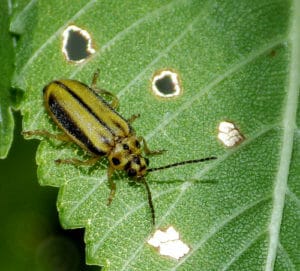
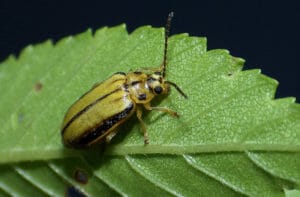
Damage this pest can cause: Elm leaf beetle larvae skeletonize leaves by eating all the tender material while leaving structural veins in place. Adult elm leaf beetles chew circular holes in leaves (also known as “shot holes” to arborists). If enough defoliation occurs, leaves may fall early and sections of the infested tree may die back.

Signs that you could have an infestation: Look for skeletonized leaves, shot holes, clusters of eggs laid on leaves in the spring, and larvae moving down the stems prior to pupation.
Elm leaf beetles are known to attack all manner of elms, including Siberian, English, American, and other elm species.

Bronze Birch Bore Beetles
Damage this pest can cause: Adult beetles cause minimal harm as they feed on birch leaves. However, the larvae of this species can cause significant damage. Adults lay eggs in cracks, under bark cracks, and in damaged areas of the tree. After the eggs have hatched, the larvae chew deeper into the bark, and they begin feeding on the phloem and xylem tissues. These larvae galleries inhibit the tree’s ability to distribute water and nutrients. Eventually, the tree may suffer dieback at its crown; if the infestation is not stopped, dieback can continue into the main stem, eventually causing tree death.

Signs that you could have an infestation: Look for 1/8”, D-shaped exit holes. These are created when the adult beetle leaves its larvae feeding gallery. Dieback at the crown is another clue that you may have a bronze birch bore beetle infection on your hands. Finally, you may be able to detect larvae chambers as bumps or ridges underneath bark.

This species attacks birches including European, Himalayan, and other ornamental birches. European and Asian birches are more susceptible to Bronze Birch Borers; native birch species with non-white bark are more resistant to the beetles, as both species evolved together.

Tree pests can be scary for arborphiles like us. But what’s really terrifying is the thought of relying on noxious chemicals to handle Elm leaf beetle on leaftree infestation problems. Massive bee deaths can be caused by certain tree pesticides—and this is only one of many negative environmental impacts. Organic pest control is not only possible; it can also be effective, if you’re working with the right Portland tree service. Call us to quell your tree pest fears. Urban Forest Pros always seeks to use organic options first; we only turn to more traditional chemical solutions when all other options have been exhausted. Give us a call for more advice on how to organically treat and prevent tree pest infestations.
 

This post first appeared on https://www.urbanforestprofessionals.com

Portland Tree Permit Series: Take Care of Tree Services Now

Residential Tree Care ServicesOn January 2nd, a new Portland tree code referred to as “Title 11 Trees” becomes law. This plan places strict guidelines on what kind of trees can be removed and also issues guidelines for pruning heritage trees. Homeowners are required to obtain these permits, but rather than trying to deal with understanding the 15 pages of guidelines and dealing with the bureaucratic process yourself, we recommend partnering with a licensed, professional tree removal service such as Urban Forest Professionals. This is the second part of our Portland Tree Permit Series. In part 1 we looked closely at the changes that will occur with the City of Portland’s Urban Forest Plan at the start of 2015.

In this post we encourage you to take care of Portland tree services, including pruning and removal, now, before the new codes take effect. We also outline what that homeowners can do this fall to prepare for winter. Getting ahead of the game now means a safer winter, with less chance of falling trees.

Fall Planting. The rains are settling in and the ground is starting to loosen up after the dry, summer months. This means its time to put the shovel in the ground and get back into the garden. Certain species, such as Hostas, Astilbes and Cranesbill geraniums, should be moved this fall, to make more room. After that, consider whether you want to move any of your shrubs. Fall planting is most recommended by arborists and horticulturalists because it gives the plant lots of time to settle in and establish new roots over the winter months.

Pruning and Removal. This is an area where professional advice is a good idea. After a long and dry summer, many shrubs and trees require pruning. It’s not always easy for the average homeowner to know which plants should be trimmed in the autumn. In addition, proper tools and training are necessary for the long-term health of your trees and shrubs. A professional Portland tree removal service, such as Urban Forest Pro, will ensure that proper and safe techniques are used, and that trees and shrubs will be maintained properly, according to their yearly cycles.

Title 11. The new Title 11 legislation is strict about what kinds of trees may be removed, and how certain heritage trees must be pruned. If you have trees that are large enough to be categorized as Title 11 (i.e. trees with a diameter of or above 12”; trees that are in the right of way or are being removed for development activities; heritage trees; and trees that are in a special district or overlay such as Johnson Creek or Pleasant Valley), we recommend dealing with them now before these regulations cause more fees and delays.

Plant now. As far as planting goes, the Title 11 guidelines also include stipulations about replacing removed trees with species that will provide an equivalent amount of foliage and shade. Even without these guidelines, the value of trees to the homeowner (and city) is enormous. For instance, trees create shade, reducing your energy costs.

The rains are here and the ground is ready for planting. In addition, many plants need to be trimmed after a long summer’s growth. Don’t wait for winter to make these changes. Call our Portland certified arborists today to discuss what you can to do prepare for winter and for the new changes that Title 11 will bring on January 2nd, 2015.

This post first appeared on https://www.urbanforestprofessionals.com

Urban Forest Pro’s Volunteer Work with Hoyt Arboretum

Everyone at Urban Forest Pro appreciates the beauty and generosity of the Portland landscape. Here, the trees are huge and the people are friendly. To give back to our community and the ecosystem that allows Portland’s urban forest to grow, we volunteer our time at Hoyt Arboretum.

What is the Hoyt Arboretum?
The Hoyt Arboretum is a living museum of trees spread over 187 acres of ridges in Portland’s West Hills. Located two miles northwest of downtown Portland and operated by the city’s award-winning Parks and Recreation department, the Hoyt Arboretum offers an incredible, cost-free opportunity for Portland families to learn about and appreciate an incredible range of trees.

Activities at Hoyt Arboretum include:
Hiking. There are 12 miles of hiking trails winding through the park. Each month, the Hoyt Arboretum highlights stunning trees Portland, OR by jeffgunn, on Flickr.comon trails. This September, for instance, Hoyt is recommending visitors take in the ‘Sango Kaku’ Japanese maple, Acer palmatum. Not only does the Sango Kaku’s leaves turn golden yellow in the fall; the tree’s bark also shifts color to a coral red that is only intensified as temperatures drop.
Informative tours on seasonal topics. This month’s talks, available for a small fee, include a tour of the park’s many maples and a discussion of the history behind common plants all around us.
Join a volunteer work party. Sign up online for monthly work parties in the park.

But most of all, the primary thing to do at Hoyt Arboretum is to…

Enjoy the Amazing Array of Trees.
There are over 6,000 trees from all over the world in Hoyt Arboretum. Over 2,000 species are found in the park, including 63 species that are classified as endangered by the International Union for Conservation of Nature and Natural Resources. Hoyt Arboretum practices ex situ conservation on its threatened species, assisting Botanic Gardens Conservation International in keeping these precious trees on our planet.

Our Portland arborists do a variety of tasks at Hoyt Arboretum. Their expertise allows for holistic plant care, as provided in our residential tree service.

Portland, Oregon residents who love trees as much as we do should see Hoyt Arboretum as their personal oasis—an island of peace in Stumptown. If you’re a tree lover, we encourage you to visit Hoyt Arboretum regularly, and sign up for volunteer opportunities to help the park thrive.

This post first appeared on https://www.urbanforestprofessionals.com

Portland Tree Permit Series: What is Title 11 Trees?

As nearly every Portland certified arborist is well aware, a new Portland tree code named “Title 11 Trees” is rolling out on 1/2/15. Title 11 Trees is part of the Urban Forest Plan, which aims to “protect the health, safety, and general welfare of the citizens of Portland” by “enhancing the quality of the urban forest and optimizing the benefits that trees provide.” The City recognizes that trees provide many benefits, including the creation of oxygen, erosion prevention, storm water filtration, reduction of storm water runoff, minimization of energy demands, visual screening, maintenance of property values, and preservation of the “beauty, character, and natural heritage” of Portland. As such, the City of Portland is changing the rules about how homeowners can prune, remove, and plant trees.

While the City’s tree ordinances previously applied mainly to commercial property owners and new developments, the new regulations also include private property owners. Today we’re reviewing how the city defines “Title 11 Trees,” i.e. those that are included under the new tree code.

Overall, the City of Portland’s Tree project aims to retain healthy trees and the urban canopy. When trees are removed, the new code requires “tree-for-tree” replacement according to the trunk diameter of the removed tree. For instance, if a tree with a 12” diameter is removed, multiple trees with smaller diameters adding to 12” may replace it. If space is unavailable for tree replacement, the city forester can waive replacement. In such a case, the property owner may be required to pay into the city’s tree fund, so that other trees may be planted elsewhere in the watershed.

Let’s take a look at the basic definitions of Title 11 trees, and how Portland homeowners will be impacted by the new urban forestry code.

What are Title 11 Trees?

Portland city treesPrivate property trees included in this new plan are defined as:

  • Trees with a diameter of 12” or larger or
  • Trees of any size that are:
  • In the right of way
  • Being removed for development activities.
  • Heritage Trees, the 300+ trees in the city that have been recognized for their horticultural or historic significance, size, and/or age.
  • Included in a previous land use review.
  • Located in a special Overlay Zone, such as the Pleasant Valley Natural Resources overlay zone, or the aircraft landing zone.
  • Located in a special Plan District, such as the Johnson Creek Basin Plan District.

Whether or not they contract for Portland tree services, residents will be required to submit a permit for removal of Title 11 trees.

What does this mean for Portland homeowners?

The main change for Portland homeowners is that a permit will be required to remove a Title 11 tree as defined above. Permits will also be required for pruning private heritage trees and native trees in certain Overlay Zones. Finally, topping and heavy-handed pruning are unlawful under Title 11, and the City may categorize such activity as removal for Title 11 enforcement.

Title 11 Tree code enforcement is complex; complex enough to require 15 pages in the Title 11 legislation. Homeowners should know this: A monthly enforcement penalty may be charged for properties in violation of the new tree code. Property owners may also be required to pay for replacement trees. For trees that are damaged but still viable, residents may work with an arborist to enact a treatment regimen.

Ultimately, the easiest route for homeowners will be to partner with a professional Portland tree removal service such as Urban Forest Professionals. Rather than combing through the byzantine City tree regulations, it will be far less of a hassle to contract with professional local arborists who know municipal tree codes in and out.

This post first appeared on https://www.urbanforestprofessionals.com

Fall Tree Care Tips

It’s fall in Portland—apples are blushing, pumpkins are ripening, and the last round of roses bloom. As kids go back to school and the weather turns crisp, your trees are in need of attention. Just as you prepare your home for cold, wet winter temperatures with winterization, your trees will do best with winter preparation, as we outline below.

Get in touch with Portland arborists for fall pruning, which should be done every year, and is especially crucial if your trees Fall tree care inspectionhave broken branches, insect damage, or disease-ridden areas. Fall is the perfect time to schedule tree service, Portland residents. These breezy, crisp autumn days in the Rose City are perfect for outdoor work such as tree pruning and removal.

Remove risky trees—but don’t do it yourself. Any trees that are hazardous—mostly dead, leaning at an angle, unstable in winds, etc.—should be removed before harsh weather arrives. Felling a tree is hazardous work that requires considerable expertise and specialized equipment. When it comes to tree removal, Portland residents are wise to leave it to professional arborists.

Plant new trees. The workable temperature and cooler temperatures of fall make it an ideal tree-planting season. Trees can put down roots and take in soil nutrients before the harsh days of winter arrive.

Fertilize for healthy growth in the spring. How do you know if fertilization is required? It may be needed if:

–You notice wilted leaves.
–There’s been stunted/slow growth in leaves and branches.
–The tree’s leaves seem to be changing and falling earlier than they normally do.
–In trees whose leaves do not turn yellow, watch for pale green or yellow leaves.

Mulch. During the winter months, mulch acts as a blanket of protection for your trees. Mulch helps keep the soil warm and rich in nutrients. Avoid mulching directly to the trunk, which can encourage fungus growth. Leave a mulch-free ring around the trunk.

If you’re worried about a particularly sensitive tree surviving the cold winter months, you can wrap it in burlap or plastic cloth.

For any questions about tree health this fall, give your local Portland arborists a call.

This post first appeared on https://www.urbanforestprofessionals.com

Why Urban Trees are So Important

Urban TreesWhen people think of how trees and other plant life are beneficial, it’s usually in the context of the environment and large remote forests. But trees play a vital role in urban settings as well, and in more ways than you may realize.

Trees Clean the Air

Planting trees is a very affordable means of removing excess CO2 from the atmosphere. Additional pollutants can be controlled, at least in part, by trees, including nitrogen oxides, sulfur dioxides, carbon monoxide, ozone, and small particulates. Up to 60 percent of street level particulates can be reduced by trees.

Urban areas are missing plenty of opportunities. According to the National Wildlife Federation, there may be as many as 200 million spaces on our city streets with room for trees to be planted. In a perfect world, if that space had trees planted, they estimate an energy cost savings of $4 billion and the potential for absorbing 33 million additional tons of CO2 every year.

Trees Benefit the Economy

A survey revealed that 74 percent of the public preferred to patronize businesses that incorporated trees and other landscaping features around its structure and parking lots.

Trees Shrink Utility Bills

When summer heat is beating down, having trees placed in just the right spots can cut your air conditioning expense by more than 50 percent.

Trees Increase Home Values

According to Arbor National Mortgage & American Forests, the vast majority of Realtors they surveyed believe mature trees increase the salability of a home. Nearly all (98 percent) believed this to be true with homes over $250,000.

According to the Georgia Urban Forest Council, homes that are adjacent to parks and open spaces can be as much as 20 percent higher in value than comparable properties.

Trees Can Reduce Crime

A study from the University of Illinois found that urban trees “are directly correlated with lower levels of fear, fewer incivilities, and less violent and aggressive behavior.” Inner cities that are greener also tend to have a lower crime rate.

Health Benefits of Trees

Nature has the power to heal as well, and not just in its positive environmental impact. In 1984, environmental psychologist Roger Ulrich was the first to use modern medical research standards to prove what many of us already know from firsthand experience… that being around our natural environment makes us feel better.

But Ulrich’s study found that hospital patients who had window views of leafy trees healed faster, needed significantly fewer pain medications, and experienced fewer post-surgery complications.

The impact trees have on our society, from health to economics, is immeasurable. By planting a tree, in your own small way, you are contributing to a much bigger purpose that can reach beyond the beauty it brings to your property.

This post first appeared on https://www.urbanforestprofessionals.com

This website nor its owners are an actual service provider, this website is a referral service. When you place a phone call from this website, it will route you to a licensed, professional service provider that serves your area. For more information refer to our terms of service.

© TreeRemovalandTrimming.com

(877) 959-3534